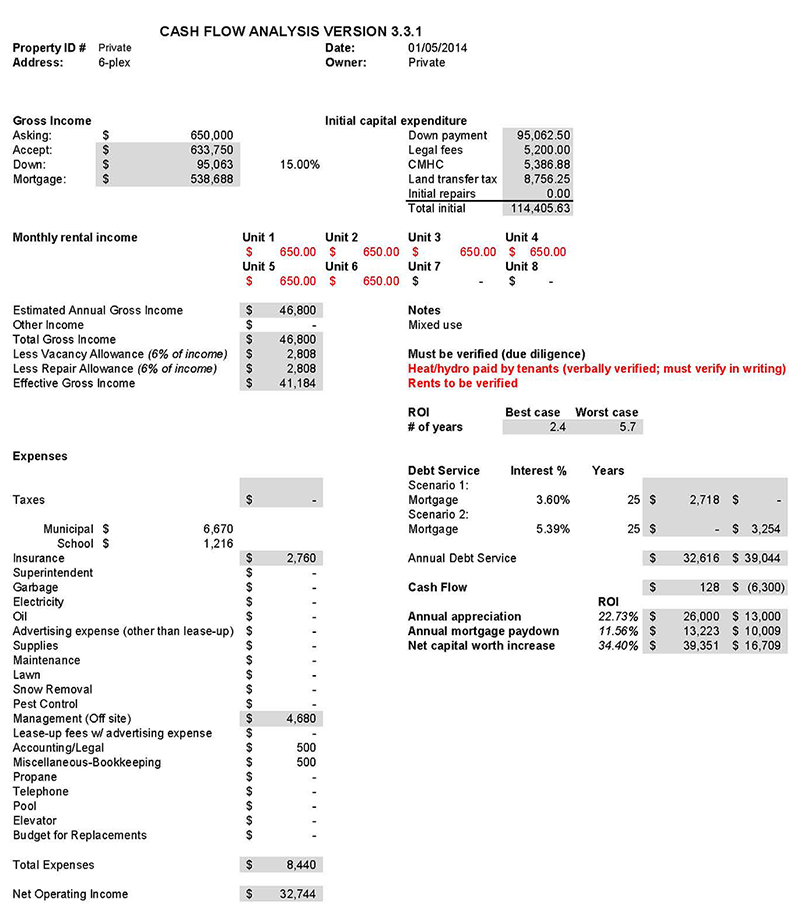
This is what a real estate cashflow analysis looks like. It informs you of your up-front costs, assesses cashflow positivity with current and potential future scenarios, budgets appropriately for vacancy/repair/contingency and accounts for overhead costs even if they may be unrealized (e.g. property management, accounting, bookkeeping, etc.). It is also vital to highlight any assumptions and verify them in writing, absolutely no exceptions.
Get Over Your Fears and Take Action Today!
By the end of 2011, I had completed nine years of real estate investment courses. Acquisition, cashflow, buy & hold, flipping, landlording, rent to own, taxation law… the list goes on and on.
Despite my educational knowledge, I still had not yet purchased a single investment property. Even though I had successfully run my own company for the previous fifteen years with positive cashflow in each and every year, I was still afraid to take the plunge.
I kept asking myself “How could I take so many calculated risks but be afraid to take this one?” I was stuck in a state of fear commonly coined as “analysis paralysis”. I would look for the perfect deal but before I would pull the trigger I’d make up excuses as to why each potential deal wouldn’t work. The truth is there’s no such thing as a perfect deal. The human mind can be our own worst enemy and I was battling against nobody other than myself. Trying to psyche myself into taking the next step, but for some reason I kept backing down, convincing myself as to why each opportunity wasn’t optimal.
In mid-2012 I booked vacation. I decided to stay home and relax. The previous two years’ vacation was spent repairing the house after extensive water damage which had nearly depleted all of my savings. It was early afternoon and I grabbed an ice cold Corona from the fridge and went to sit in the yard and do some reading. As I hunched down in my lounge chair I continued to read my latest real estate investment book. My attention was drifting in and out and I found myself reading and re-reading the materials. I felt frustration growing within me as I thought to myself “I know this s&%t. I’ve read it a hundred times in other books.” I stood up and blurted “That’s it! I’m going to buy a property or I’m going to stop reading about real estate investing.” That was the catalyst, the last nudge through the barrier of procrastination, the trigger required to break through my analysis paralysis.
Do You Feel Like You’re Coasting Through Life? Turn Off Autopilot!

Days become weeks, weeks become months, life begins to blur. We settle in and accept the status quo. “It is what it is” we tell ourselves because it’s all we know. We follow routines. There are slight deviations but for the most part the pattern is nearly identical. We are bored. We daydream about the future – our next vacation, our next evening out, even our next weekend. We fail to enjoy the present. Seize the day, carpe diem, YOLO – these are buzzwords that we say but rarely that we do.
Every few months we vow to change things. We pledge to live each moment like it’s our last. We go out and do something we’ve been wanting to. We call up friends and make plans. We escape the routine with a getaway. But then we let the normal sink back in and life continues to blur by us.
How can I make money in real estate?
Earlier this week I had a meeting with one of the local startups that I am mentoring. Over the last year his company’s bank account has been reaping the rewards of their hard work and so he has been considering his best option to invest the returns from his compounding successes.
Knowing that I am an active real estate investor he wanted to learn about how real estate makes money. He had performed a number of cashflow analyses, but, was failing to find lucrative returns. I could sense his frustration mounting in each additional word that he was saying. “The best cashflow I’ve been able to find is approximately 8% on a real estate investment and that’s just… well average”. He frowned. I smiled and excitedly said “That’s fantastic, you should put in an offer, do your due diligence and buy this property if everything checks out.”
The Most Important Step to Retire Early
A few months ago I was asked a very interesting question by one of my financial freedom students. She asked “If you could only give me one single piece of advice, what would it be?”
I sat there quietly pondering my response for what was likely several minutes as she looked on waiting. In my mind I was considering the path that I’ve taken towards financial freedom. I took time to contemplate the challenges, consider the obstacles and reflect upon the successes along the way.
Alas I broke the silence with my response, “Invest now“.
“That’s it?” she blurted out, “that’s the best advice you can give me?”
Kickstarting a Retirement Plan for Small Business Owners
Over the last few years I’ve been blessed with the opportunity to mentor dozens of small business owners. Helping entrepreneurs to monetize their passions is extremely exciting. I learn a lot about various industries while helping entrepreneurs leverage their strengths and recognize their weaknesses.
One of the most troubling weaknesses that I’ve been helping entrepreneurs with is their lack of personal financial awareness. Most entrepreneurs have very little savings and no idea how to get started. This creates a significant risk for the majority of our small businesses, which more than 77% of all businesses fail due to lack of financial responsibility and awareness*.
Why should I start now?
Every business owner I’ve ever met has numerous tales of seemingly insurmountable challenges. These challenges typically share a common theme, one of a financial nature. This is one of the most difficult challenges to deal with – it causes stress, challenges…
View original post 604 more words
What’s the Real Cost of Wanting More?
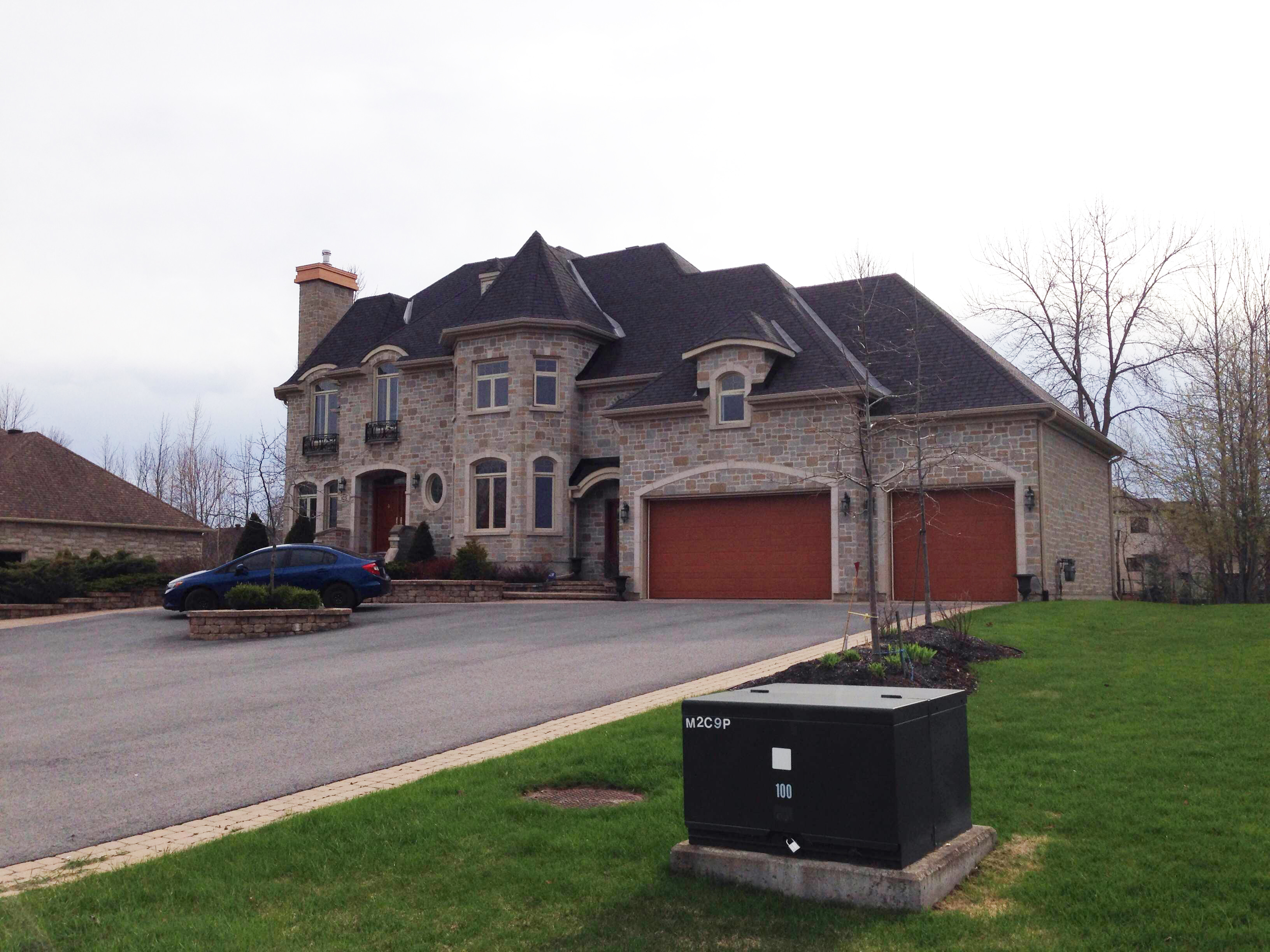
At last it’s Springtime! Warmer weather, the trees are budding, the grass is coming back to life. It’s wonderful! This week I’ve gotten to enjoy outdoor exercise every day. Last night as I biked surrounding neighborhoods I noticed a number of luxury homes for sale so I snapped a few photos.
![]() |
![]() |
![]() |
Just for fun I thought it would be an entertaining exercise to determine the cost of living in one of these houses. After researching I found most similar houses in this neighbourhood ranged in price from $950,000 to $1,299,999 ($1,577,397 to $2,158,542 after mortgage financing at 4.5% average interest rate over 25 years). For the most part these houses featured 5 bedrooms and 4 bathrooms and include a living room, family room, dining room and eat-in kitchen.
Let’s forget the financials for a moment and the fact that there are single family homes a few streets over for $315,000 to $399,000 ($523,032 to $662,508 after mortgage financing at 4.5% average interest rate over 25 years). These houses have 4 bedrooms and 2 bathrooms and include a living room and dining room.
Why are we so motivated to buy bigger all of the time? More importantly does it actually increase our daily happiness? Does the happiness justify spending an extra $1 million to $1.5 million (which is really $1.5 million to $2.25 million in salary earned before income tax is deducted)?
Stop Justifying the Cost of a Bigger House, You Are Imprisoning Yourself!
While I’ve written many blogs in the past about first-world slavery (Are You a Slave to Consumerism?, Start Working for Yourself without Quitting Your Job!), I find myself inclined to write another blog on yet the very same topic yet framed in a different manner. The reason I’m inclined to do so is that first-world slavery is a tough disease to battle because it’s fed by some very resilient bacteria known as misinformation and denial.
Now before you take offense and storm off, take a moment to bear with me and read this through. Believe me, if this blog gets through to you, I guarantee it will transform your life in ways you couldn’t have imagined. I may have just added another decade or two to your happy retirement!
Take a moment and write this down: “I want a bigger house because…” Now, take a couple of minutes and write down all of the reasons that you want to buy a bigger house (or possibly even renovate your current one). Once you’re done that, take a couple more minutes and write them onto two separate sheets – want and need. I’ve done this exercise a number of times during my financial freedom workshops and in most cases, if you are being honest with yourself, the items will all end up on the want sheet (bigger yard, more rooms, balcony, higher end finish), in very few scenarios items may end up on the need sheet (new baby arriving, moving for work, etc.). Be careful and be honest with yourself – the only individual who will pay the long-term consequence for any stretching of the truth in this scenario is you.
Is it cheaper to buy a house and live in Ottawa, Ontario or Gatineau, Quebec?
Several times a month I’m asked by individuals for advice on buying a house in Ottawa, Ontario or Gatineau, Quebec. While I will refrain from commenting on the personal elements (e.g. politics, etc.) as they are subjective, I’ve put together a financial analysis for those who wish to consider.
In conclusion, unless an individual earns more than $150,000 / year, from a financial perspective, it’s still significantly financially beneficial to live in Gatineau, Quebec vs. Ottawa, Ontario.
Here’s the facts. For this assessment we’ll use the salary of $75,000… (reference for calculations: http://bit.ly/RLVw04)
No more excuses! Achieve your dreams by taking action!
For 9 years I took course after course on real estate investing. Topics spanned residential, commercial, legal, taxation and the list goes on… Despite thousands of hours of time and tens of thousands of dollars in education, I was always finding a reason to never take that first step, even though, in reality I was ready after only a few years of courses.
One day towards the end of 2010, I woke up and told myself that I would finally just do it. I would buy some investment real estate. And I did.
Now only 2 years later, I’ve built up a real estate portfolio of 18 properties and on my way to owning 100 in the next 8 years. Sure there were challenges and surprises along the way, but, now I’m much closer to achieving my dreams. Don’t make my mistake. Don’t let excuses get in your way of success. If I kept saying “I’m too busy”, “It’s too risky”, “I’m too afraid”, I would never be where I am today.
So, the choice is yours, what are you going to do? Make an excuse (or) take action. Your dreams are entirely within reach, it’s up to you whether or not you take action to achieve them.
–
Brent Mondoux
Founding Partner, Amplified Investments
brent@amplifiedinvestments.com